


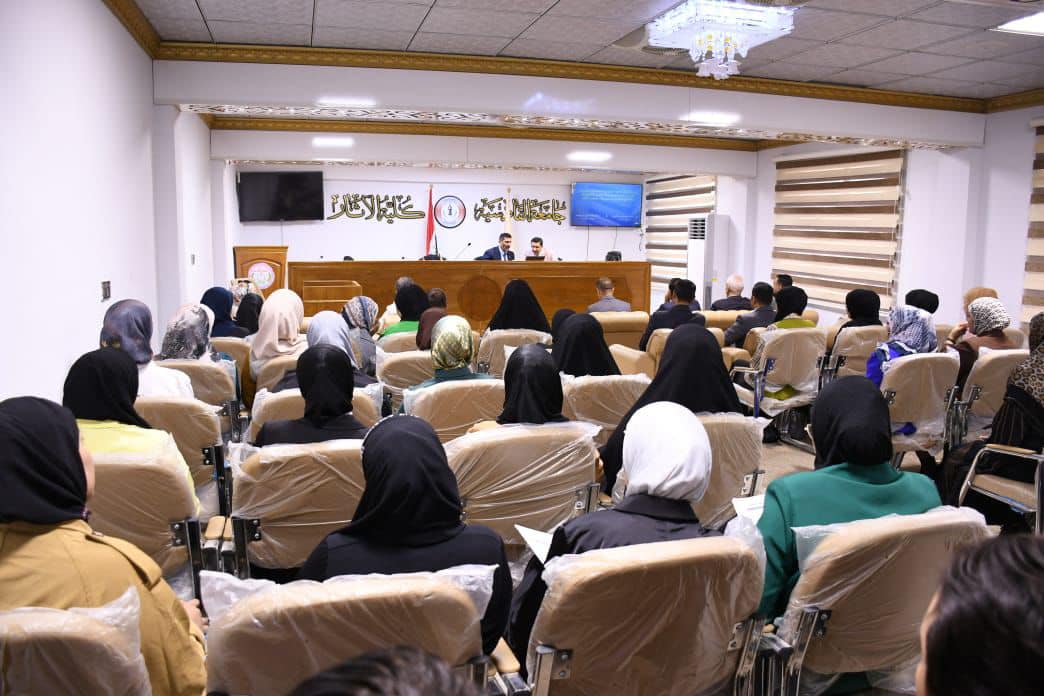
Under the patronage of the President of Al-Qadisiyah University, Professor Dr. Kazem Jaber Al-Jubouri, and under the supervision of the Dean of the College of Archaeology, Assistant Professor Dr. Rajwan Faisal Al-Miyali, the College of Archaeology organized a scientific discussion session titled “Lapis Lazuli: Its Mines and Uses in Mesopotamia during the Third Millennium BC.” The session was presented by Assistant Professor Dr. Ahmed Saeed Yassin Al-Ghareeri and Dr. Furqan Alaa Al-Din Badr.
The discussion session provided a detailed presentation on lapis lazuli, which was recognized by the peoples of the ancient world since the fifth millennium BC. It gained a sacred character in the cultures of those peoples due to its blue color, reminiscent of the sky, and is considered a semi-precious stone formed by the interaction of carbonate rocks (such as limestone or dolomite) with magma, making it a rare stone that is extremely difficult to obtain. Ancient civilizations revered it to the extent that it became more valuable than other precious metals, such as gold.
The discussion concluded that the development of lapis lazuli trade with the civilizations of ancient Iraq was linked to its rarity and spiritual value, as it was used alongside gold in the production of statues of deities and effigies of priests and priestesses, particularly in the third millennium BC.


لا تعليق