


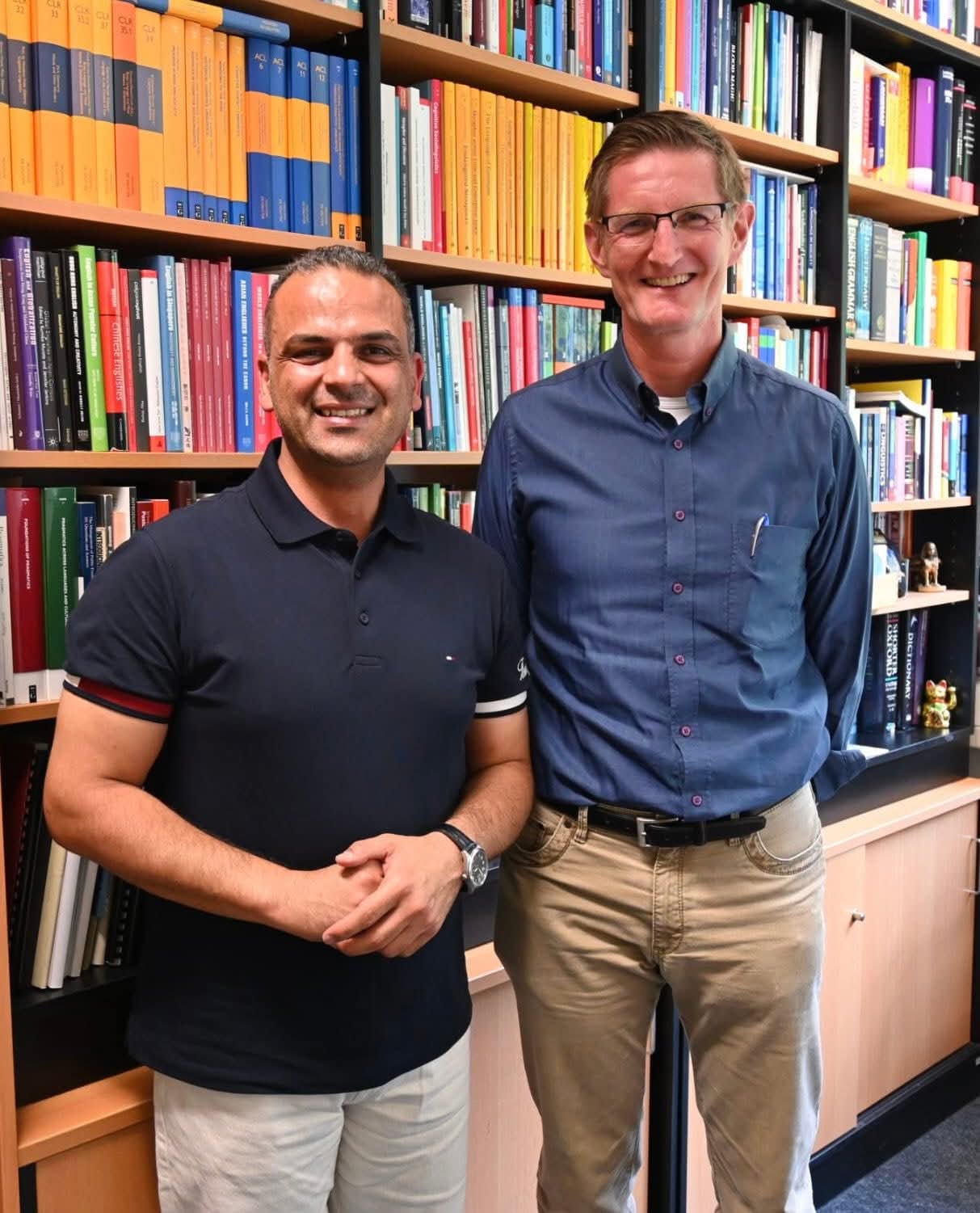
Professor Dr. Sami Bashir Al-Hasnawi, a faculty member in the English Department at the College of Education, Al-Qadisiyah University, contributed a chapter to this international collaborative work in collaboration with Prof. Dr. Hans-Georg Wolf from the University of Potsdam, Germany
https://www.uni-potsdam.de/de/iaa-dvel/academic-staff/prof-dr-hans-georg-wolf?utm_source=chatgpt.com
This research, part of a DAAD grant, is included as a chapter in the Routledge Handbook of Language and Culture.
In this work, Professor Sami Al-Hasnawi explores the concept of culture as a complex and multidimensional structure that transcends fixed or singular essentialist definitions. He emphasizes that culture is not a closed or pure entity, but rather the product of ongoing processes of interaction, negotiation, and historical exchange between societies. In this context, the work highlights the importance of concepts such as “cultural hybridity” and “acculturation” as analytical tools that contribute to deconstructing traditional dichotomies (such as self/other, East/West) and reconsidering representations of culture within academic and educational discourses. This fosters a more dynamic and comprehensive understanding of cultural identities in globalized and interconnected contexts.
Starting from this complex conception of culture, the work moves to an analysis of the organic relationship between culture and language, with a particular focus on English as a global phenomenon with historical and political dimensions. It demonstrates that the spread of English was not merely a result of communication necessities but was closely linked to the processes of colonialism and then globalization, contributing to the formation of cognitive patterns and cultural representations that often reflect Anglo-Saxon centrism. The work also discusses how this linguistic hegemony has led to the production of symbolic and social inequalities, particularly in educational contexts, where values and cognitive norms are reformulated according to frameworks associated with the English language. However, the work calls for a balanced, critical approach that acknowledges the vital role of English in facilitating global knowledge exchange, while simultaneously emphasizing the need to examine its impact on perpetuating inequality and to work towards more equitable and pluralistic linguistic and cultural practices.

لا تعليق