


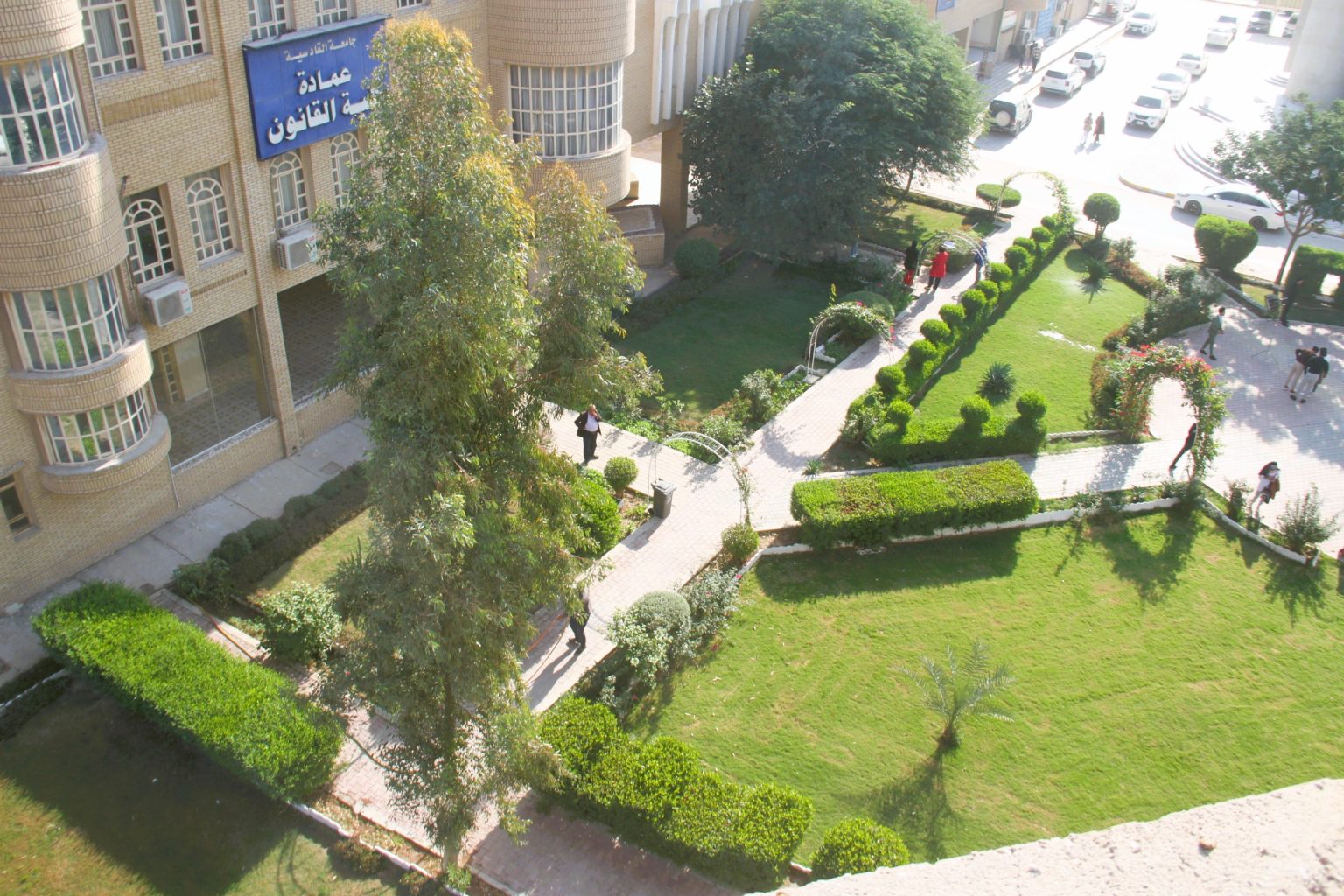
The College of Law at Al-Qadisiyah University seeks to be a model for achieving sustainable development by developing a green university environment that balances modern infrastructure with natural open spaces. This approach is part of the university’s policy aimed at making the campus friendly to humans and nature, in line with the internationally recognized “Green Campus” standards.
The college’s buildings are distributed within the campus over a total area of approximately 17,000 square meters, surrounded by extensive gardens and planted areas that give the area a tranquil feel, harmonious with the natural surroundings. Green spaces and shady trees form an important part of the campus design. The college is home to a number of local trees, such as jujube and acacia. The planted forest area amounts to approximately 6,100 square meters, while plants and flowers occupy an estimated 35% of the total area. These spaces are regularly maintained to ensure their sustainability and improve air quality within the college.
As part of its commitment to protecting the environment, the college, in coordination with the university’s Environment Division, works to conserve local plants and encourage the cultivation of drought-resistant native species, while ensuring no harm is done to the living organisms on campus. These efforts are in line with national and global goals for food security and biodiversity. The college also uses modern irrigation systems to rationalize water consumption using drip irrigation and smart watering scheduling. The average annual water consumption is approximately 4,709 m³, including irrigation, gardening, and forestry.
During the COVID-19 pandemic, the college maintained its maintenance and operational activities while implementing strict safety procedures and continuous sterilization of buildings and corridors. It also continued to provide academic services via e-learning to ensure the sustainability of the educational process in a safe and healthy environment. This commitment demonstrates the college’s resilience in dealing with crises.
The college also places great importance on security, safety, and public health facilities. It is equipped with fire-fighting equipment, alarms, and surveillance cameras in all corridors and halls. A security and safety subcommittee also conducts periodic safe evacuation drills.
The college also features clean roads and sidewalks lined with vegetation, which reduces dust and gives the space a harmonious, urban appearance. The design of these corridors takes into account the needs of people with disabilities by creating ramps and paths designed to facilitate their movement within the college corridors without obstacles. The open spaces provide an environmental and social outlet for students, covering approximately 5,000 square meters, or an average of 5.3 square meters per student, reflecting the balance between population density and the natural environment.
Overall, the College of Law has succeeded in translating the concept of a green campus into practical practices that combine sound urban planning with ongoing environmental awareness. Through these efforts, the college affirms its commitment to achieving sustainable development goals by spreading environmental awareness, rationalizing resource use, and strengthening partnerships with relevant authorities to maintain a healthy and balanced university environment, a model to be emulated by Iraqi higher education institutions.


لا تعليق