


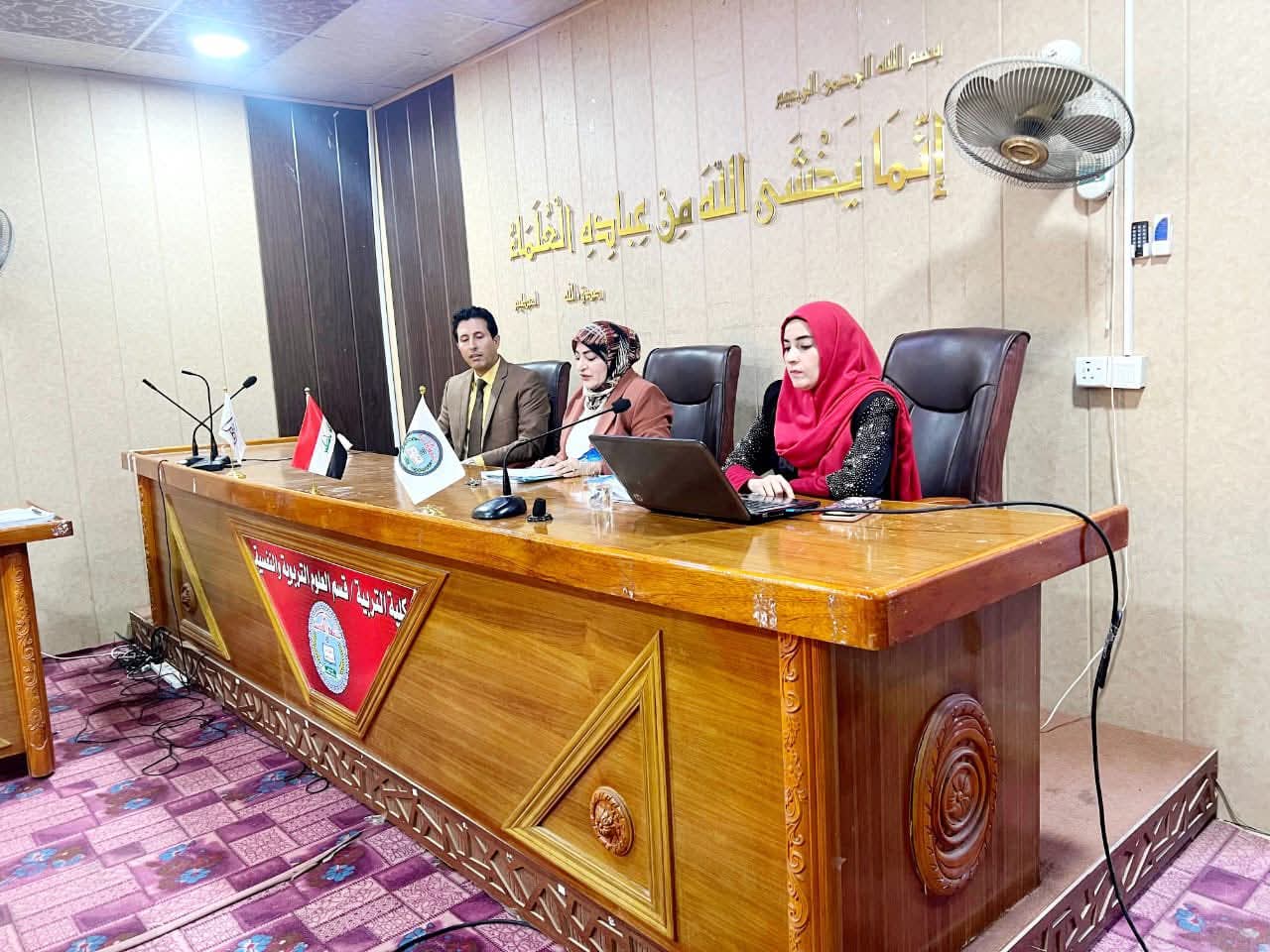
Under the patronage of the President of Al-Qadisiyah University, Professor Dr. Rahi Kalf Mahdi Al-Yasiri, and under the supervision of the Dean of the College of Education, Professor Dr. Sattar Hamid Hamza Al-Janabi, and in coordination with the Deputy Governor, Engineer Kazim Obaidi Al-Abdan, Chairman of the Subcommittee on Combating Violent Extremism Leading to Terrorism, the Department of Educational and Psychological Sciences at the College of Education, in cooperation with the aforementioned committee, held a scientific symposium entitled:
“Decision-making between Moderation and Extremism.”
The symposium featured the following:
– Prof. Dr. Irtiqa Yahya Hafez / Department of Educational and Psychological Sciences
– Asst. Prof. Dr. Saddam Hussein Abbas / Department of Educational and Psychological Sciences
– Asst. Dr. Khitam Muhammad Hassan Abbas / Head of the Women’s Affairs Division at the University Presidency / Member of the Subcommittee on Combating Violent Extremism Leading to Terrorism in Diwaniyah
The symposium included several key themes, most notably:
The first theme: The role of thought in guiding behavior and successful decision-making.
The second axis: The impact of emotion in shaping attitudes and intellectual orientations.
The third axis: The dialectical relationship between extremism and moderation and decision-making.
The fourth axis: Mechanisms for promoting balanced thinking in educational institutions, including universities.
The fifth axis: Community experiences in confronting extremism and promoting the values of constructive dialogue.
The symposium concluded with several recommendations, most notably:
– Strengthening the role of the media in spreading the values of tolerance and rejecting extremism.
– Analyzing the psychological and intellectual causes that lead to extremism and intellectual closure.
– Promoting a culture of moderation and centrism as an intellectual and behavioral value in making important life decisions.
– Adopting the approach of dialogue as an effective means of addressing intellectual differences within the family and educational institutions.
– Encouraging youth volunteer initiatives that promote a culture of coexistence and moderation.
– Developing psychological and social counseling programs to help individuals understand the mechanisms for dealing with emotional and intellectual conflicts to reach optimal decisions

لا تعليق